What is AI transformation? (And what it isn’t)

A testable definition of AI transformation, how it differs from AI adoption and digital transformation, why the IBM and Hackett definitions stop short, and the four stages every company passes through.
11 min read
01
A WORKING DEFINITION
02
WHAT IT ISN’T
03
THE FOUR STAGES

TL;DR
AI transformation is the redesign of a company’s operating model (data, systems, processes and decision rights) so that AI can act inside core workflows with a named owner and a measured business outcome. Everything in that sentence can be checked.
Deloitte’s 2026 State of AI in the Enterprise puts 37% of companies at surface-level AI use, 30% redesigning key processes and 34% transforming deeply; only 25% have moved more than 40% of their pilots into production.
AI adoption puts tools in people’s hands. Digital transformation moved work into software. AI transformation changes who, or what, does the work inside that software, which forces questions the last wave could postpone: who owns the decision, which system is the truth, who can switch it off.
Companies pass through four stages: Exploring, Piloting, Scaling and AI-native. Most mid-market companies we meet are Piloting and believe they are Scaling. One question settles it: did the second AI use case reuse the first one’s data foundation, or rebuild its own?
The phrase is everywhere. The thing is rare.
Somewhere in your company there is a slide with the words “AI transformation” on it. It may be in the board deck, the annual plan or a vendor proposal, and it almost certainly means something different in each. In one it means the Copilot licenses. In another it means the chatbot support switched on over a weekend last spring. The phrase has become a label for activity, and activity is not what the numbers reward.
Deloitte’s 2026 State of AI in the Enterprise, a January survey of 3,235 leaders, sorted companies by how deeply AI had changed the way they work. 37% described their use as surface-level, 30% said they were redesigning key processes, and 34% said they were transforming deeply. Only 25% had moved more than 40% of their pilots into production. Read together, that is a majority of companies doing something with AI and a minority changing anything because of it. Gartner’s September 2026 C-suite survey draws the same line from another angle: 22% of organizations have scaled AI across more than one business unit.
A working definition
AI transformation is the redesign of a company’s operating model - its data, systems, processes and decision rights - so that AI can act inside core workflows, with a named owner and a measured business outcome.
Every clause is doing work. Operating model rather than technology stack, because the technology is now the easy part to buy. Act rather than assist, because the change that matters is when the CRM updates the Opportunity itself, not when it drafts an email for a rep to send. Core workflows rather than pilots, because a workflow that carries revenue or service load is the only place a change shows up in the P&L. And a named owner with a measured outcome, because in our experience that is the strongest single predictor of whether any of the rest survives a budget cycle.
For a 300–2,000-person technology company running Salesforce or HubSpot, the definition turns into a short list. One system of record per business object. Definitions of lead, opportunity, customer and churn written down. Integrations that carry context between the CRM, billing and support without a person in the middle. A small number of AI-driven workflows, each with an owner and a baseline. Everything else is infrastructure for that list.
How the big houses define it, and where the definitions stop
IBM’s definition is the one most search engines show first: AI transformation is “a strategic initiative whereby a business adopts and integrates artificial intelligence (AI) into its operations, products and services to drive innovation, efficiency and growth.” The Hackett Group is a little more demanding, calling it “the strategic integration of artificial intelligence across an organization’s operations, decision-making, and business models to drive measurable performance improvement and innovation,” and adding that it “goes beyond technology adoption.” Both are correct. Neither tells you whether your company has done it.
Deloitte’s AI Institute gets closer with a question rather than a definition. In its June 2026 predictions the test is “whether AI is simply speeding up an existing process, or whether it is helping teams rethink the process itself.” Its own data shows how rarely the second happens: 48% of companies introduced AI without redesigning workflows at all, and 12% redesigned them at scale. BCG frames the journey as three moves, Deploy, Reshape and Invent, and puts a ratio on where the effort goes: 10% algorithms, 20% technology and data, 70% people and process. McKinsey’s June 2026 work on AI-native companies adds the measure we find most useful. Judge a transformation by what the business now attempts that it could not attempt before.
The serious definitions all locate the transformation in the operating model rather than the tools, and all of them imply a test without stating one. Ours makes the test explicit: owner, outcome, a workflow in production, and a foundation the AI can act on. The diagram below sets the two sides of that line next to each other, because the difference between deploying AI and transforming with it is easier to see as a table than to argue in prose.

What AI transformation isn’t
Most of the confusion around the term comes from a handful of things that look like a transformation from a distance and are not. Each has a tell.
It is not a tool rollout
Licensing an AI layer inside Salesforce, HubSpot or Microsoft 365 is the entry fee. On its own it changes nothing, and the evidence that companies do it anyway is overwhelming. IBM’s 2025 CEO study found 64% of chief executives admit they invest in technology before understanding its value, and 50% say the past two years of AI investment have left them with disconnected, piecemeal technology. Gartner’s May 2026 research adds a detail worth sitting with: 88% of employees who have enterprise AI tools also use personal ones. That is what it looks like when the rollout happened and the work did not change to fit it.
The tell: the initiative is measured in seats activated and prompts per employee. Those are adoption numbers. A transformation is measured in the numbers the board already tracks.
It is not a pilot, however good the demo
A pilot is a controlled experiment on a real workflow, usually fed by data someone prepared by hand. It is a legitimate step. It is also where most companies stop. MIT’s Project NANDA found that 95% of generative-AI pilots deliver no measurable P&L impact, against $30–40 billion of enterprise spending. BCG’s October 2024 survey of 1,000 executives found only 26% had moved beyond proof of concept. Deloitte’s 2026 figure, 25% of companies moving more than 40% of pilots to production, is a year newer and no kinder.
The tell: ask what happens to the pilot if the one analyst who refreshes its spreadsheet every Monday leaves. If it stops, it was never connected to the operation it was meant to change.
It is not a data-science project
Models are almost never the constraint in a mid-market company. BCG’s 10-20-70 rule puts algorithms at a tenth of the effort. What decides the outcome is whether the data is what Gartner calls AI-ready, “representative of the use case, of every pattern, errors, outliers and unexpected emergence,” and whether the process the model sits inside is documented well enough for it to follow. A good lead-scoring model pointed at a Lead object whose Industry picklist has three spellings of “Software” will score three industries, and nobody will notice for a quarter.
It is not digital transformation, round two
This is the comparison people search for most, and it deserves a precise answer. Digital transformation moved work into software: paper to CRM, phone to ticketing, spreadsheet to ERP. The humans stayed in the loop, and because they did, every ambiguity in the data or the process had a person to absorb it. A rep noticed the duplicate Account. A finance analyst reconciled marketing’s definition of a customer with billing’s. Gartner’s April 2026 CEO survey puts the shift in one line: digital business changed what the organization does; autonomous business changes how it does it.
AI transformation changes who, or what, does the work inside the software the last wave put in place. Agents do not reconcile. They execute. That is why this wave forces questions the last one could postpone: who owns this decision, what data is it allowed to use, how will we know it was right, who can switch it off. Gartner’s May 2025 CEO survey found 66% of chief executives believe their current business model is not fit for AI, which is a polite way of saying the same thing.
AI adoption, digital transformation, AI transformation: three different things
Because the three terms get used interchangeably, here is how we separate them.
AI adoption: people and teams use AI tools. The unit is a license or a use case; the measure is usage. Nearly universal, at 88% of organizations in McKinsey’s 2025 State of AI, and worth very little on its own.
Digital transformation: work moves into software and records become data. The unit is a system; the measure is process coverage. Mostly finished in mid-market tech companies, often untidily, which is why the data underneath is the problem now.
AI transformation: the operating model is redesigned so AI can act on the data, inside the workflows, with accountable owners. The unit is a workflow in production; the measure is a business outcome. Rare. Deloitte counts about a third of companies transforming deeply, and the pilot-to-production numbers suggest the true share is lower.
It is not optional in the way the last wave was
A company could sit out digital transformation for years and survive on paper and goodwill. This wave is arriving through the platforms the company already runs. Salesforce prices Agentforce per agent action and frames the opportunity as a $6 trillion digital-labor market; whatever you make of the number, the vendor is rebuilding its product around agents, and HubSpot and Microsoft are doing the same. Gartner’s April 2026 survey found 80% of CEOs expect AI to force high-to-medium change to their operational capabilities. Your operating model will be reshaped by that either by design or by default.
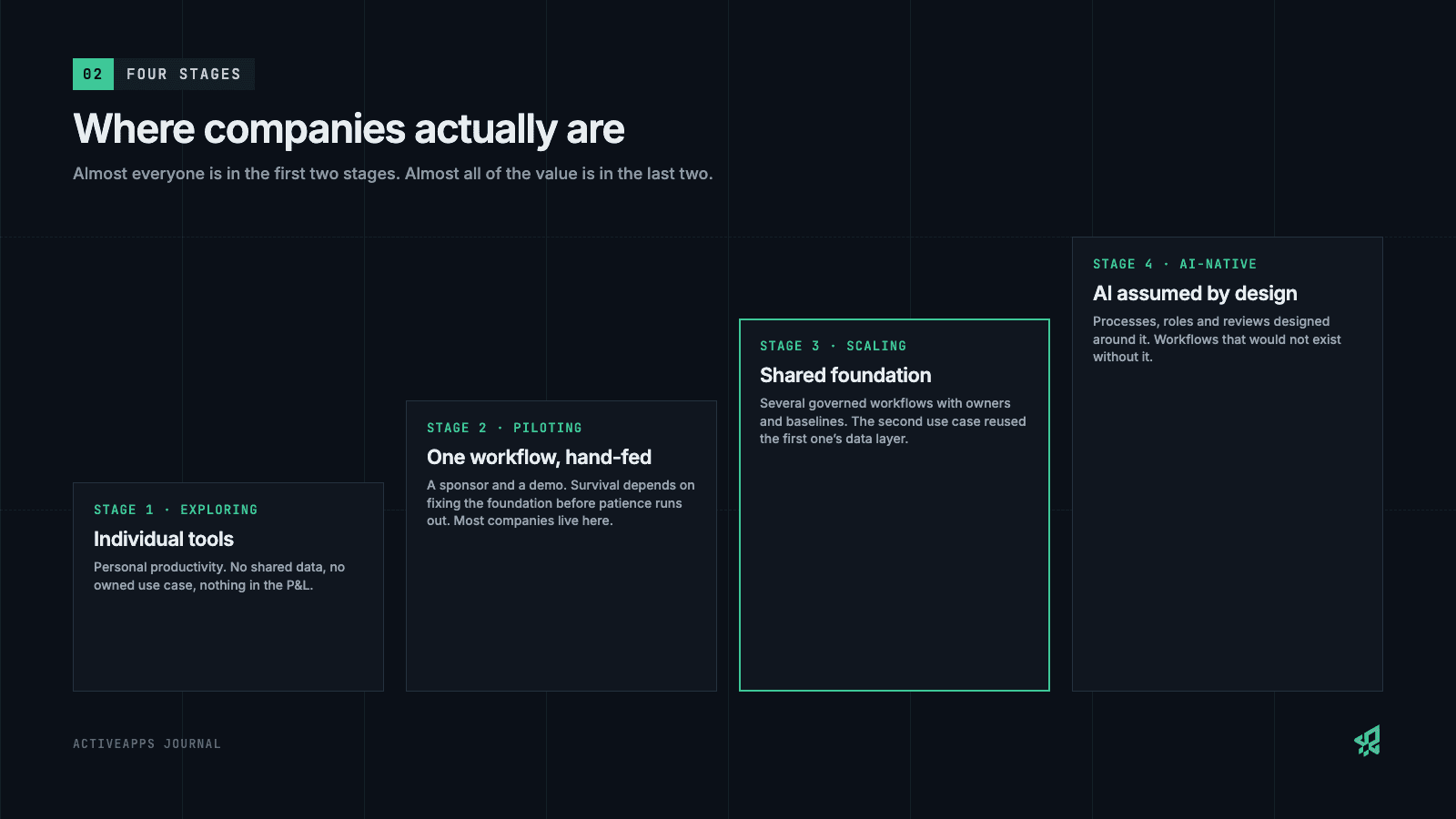
The four stages
A transformation is a direction, so it helps to know where the company stands on the road. We use four stages. They are deliberately plain, and they line up closely enough with the larger frameworks (MIT CISR’s four stages, Gartner’s five levels, BCG’s laggards, scalers and future-built) that the comparison is instructive. The companion post on stages goes through that mapping; here is the short version.
Stage 1, Exploring. Individuals use AI tools. No shared data foundation, no owned use case, no metric. The value is real and personal, and none of it reaches the P&L.
Stage 2, Piloting. A team has connected AI to one real workflow, usually on hand-prepared data. There is a sponsor and a demo. There is rarely a system of record, a written definition set or an integration that will outlive the pilot.
Stage 3, Scaling. Several workflows run on AI inside governed systems, each with an owner and a baseline. The data foundation is shared: the second use case reused the first one’s pipelines, definitions and permissions, and cost per use case falls with each addition.
Stage 4, AI-native. AI is assumed in how processes are designed, how roles are written and how decisions are reviewed. The company builds workflows that would not exist without it, and governance is a routine rather than an event.
The distribution across those stages is lopsided in every survey we have seen. MIT CISR’s December 2024 study of 721 companies put 28% in its first stage, 34% building pilots, 31% industrializing and 7% future-ready. BCG’s September 2025 survey of 1,250 executives found 60% laggards, 35% scalers and 5% future-built. McKinsey’s Superagency research had 1% of leaders describing their company as mature. Different instruments, same shape: nearly everyone in the first two stages, nearly all of the value in the last two.
What we actually see
This is a pattern from our own engagements rather than a controlled study, and the sample is skewed toward mid-market technology companies that were already worried enough to call. Most arrive describing themselves as Scaling. Most are Piloting. The tell is a question we ask in the first hour: when you built the second AI use case, did it reuse the data foundation of the first one, or did it build its own? If it built its own, the company is in Stage 2 regardless of how many agents are running, because the next use case will cost what the last one did.
The second pattern is that the pilot is usually good. It demos well, the sponsor is committed, and it is fed by a report someone exports from Salesforce every Monday and cleans in a spreadsheet before it goes near the model. We have seen a version of that spreadsheet with a column recording which of the company’s three churn definitions each row used. That is a Stage 2 company from the inside, and it is the 95% that MIT counted.
How to start one
If the definition is the operating model, the first steps are decisions rather than software. In order:
Name one accountable executive and one flagship workflow with a number the board already tracks, such as lead-to-opportunity conversion or first-response time. Put that number in one person’s goals.
Write down the system of record for each core object, and the definitions of lead, opportunity, customer, churn and revenue. Version them. This is a meeting, not a project, and it is the step most companies skip.
Replace the human bridges inside the flagship workflow with maintained integrations, and document the workflow as decision rules: what escalates, what is never promised, which fields change and when.
Record the baseline, then choose the AI layer. Agentforce, Breeze, Copilot or a custom agent will each do a reasonable job once there is something solid to act on.
Reuse before you add. The second use case must run on the first one’s foundation. If it needs its own pipeline, stop and fix the foundation instead.
Companies that start from the AI layer end up doing this list anyway, later and under pressure. Companies that start from the list are in production within a quarter. The full instrument we run before any AI work, the AI Readiness Health Check, is published as an open checklist for exactly this purpose.
Related reading
AI transformation: the complete guide for mid-market technology companies - the long-form version of this definition, with the roadmap and FAQ.
From pilot to AI-native: the four stages and how to know which one you’re in - the four stages in detail.
Five ways to make sure your organization is actually AI-enabled - the five structural tests.
The world is changing. Is your organization part of it? - the executive view.
Sources: Deloitte, State of AI in the Enterprise 2026; Deloitte AI Institute, AI transformation predictions, June 2026; Gartner, C-Suite AI Survey, September 2026; Gartner, CEO surveys, April 2026 and May 2025; Gartner, people-centric AI strategy research, May 2026; Gartner, “AI-Ready Data”; IBM, “What is AI transformation?”; The Hackett Group, AI transformation glossary; IBM, 2025 CEO Study; BCG, The Leader’s Guide to Transforming with AI; BCG, AI adoption survey, October 2024; BCG, Widening AI Value Gap, September 2025; McKinsey, The State of AI 2025; McKinsey, Superagency in the Workplace; McKinsey, The Seven Operating Truths of AI-Native Companies, June 2026; MIT CISR, AI maturity study, December 2024; MIT Project NANDA, The GenAI Divide 2025; Salesforce, digital labor research.
Frequently asked questions
What is AI transformation in simple terms?
AI transformation is the redesign of how a company operates, covering its data, systems, processes and decision rights, so that AI can do real work inside core workflows with a named owner and a measured result. Buying AI tools is adoption. Changing the operating model so those tools can act reliably, and measuring the business outcome, is transformation.
What is the difference between AI transformation and digital transformation?
Digital transformation moved work into software and kept people in the loop to absorb ambiguity. AI transformation changes who does the work inside that software: agents execute rather than reconcile, so decisions about data ownership, definitions, permissions and oversight can no longer be postponed. Gartner’s framing is that digital business changed what a company does, while autonomous business changes how.
What is the difference between AI adoption and AI transformation?
AI adoption is people using AI tools; it is measured in seats and usage and, per McKinsey, is already at 88% of organizations. AI transformation is the operating model being redesigned so AI runs production workflows with owners and outcomes. A company can have very high adoption and no transformation, which is where most mid-market companies are today.
What are the stages of AI transformation?
We use four: Exploring (individuals use tools), Piloting (one workflow on hand-prepared data), Scaling (several governed workflows sharing one data foundation) and AI-native (processes and roles designed around AI). MIT CISR’s four-stage model puts 62% of companies in the first two stages and 7% in the last; BCG’s split is 60% laggards, 35% scalers and 5% future-built.
Why do AI transformations fail?
Usually because they start from the tool rather than the operating model. MIT found 95% of generative-AI pilots show no P&L impact, and the causes repeat: hand-prepared data nobody maintains, an undocumented process the agent cannot follow, no single owner for the outcome, and a second use case that rebuilds the foundation instead of reusing it. Deloitte reports 48% of companies introduced AI without redesigning any workflow.
How long does AI transformation take?
For a 300–2,000-person company with Salesforce or HubSpot as its system of record, the foundation work for one workflow (ownership, definitions, systems of record, integrations) typically fits in a quarter, with a first production workflow in the next. Deloitte puts satisfactory ROI on a typical AI use case at two to four years; companies that do the foundation first are the ones that beat that.
NEXT STEP
See where your organization stands before the next AI purchase.
A short conversation is enough to tell whether the AI Readiness Health Check, 36 checks on your Salesforce or HubSpot org, is the right first step. No decks, no obligations.
WRITTEN BY
Tal Oryon
MORE NOTES

Perspective
The world is changing. Is your organization part of it?
In one year the platforms your company runs on rebuilt their pricing, their products and their partnerships around agents. A note to executives on the one decision that is still theirs.

AI transformation
An AI transformation roadmap for a 300–2,000-person company (12 months)
Four quarters, one workflow at a time. The deliverables, the owners and the failure mode of each quarter, written for mid-market companies that cannot afford an enterprise timeline.