Five ways to make sure your organization is actually AI-enabled

Buying AI tools is the easy part. Five structural tests separate companies where AI ships from companies where it stalls — and most mid-market firms pass two.
11 min read
01
THE GAP
02
THE FIVE TESTS
03
WHERE TO START

TL;DR
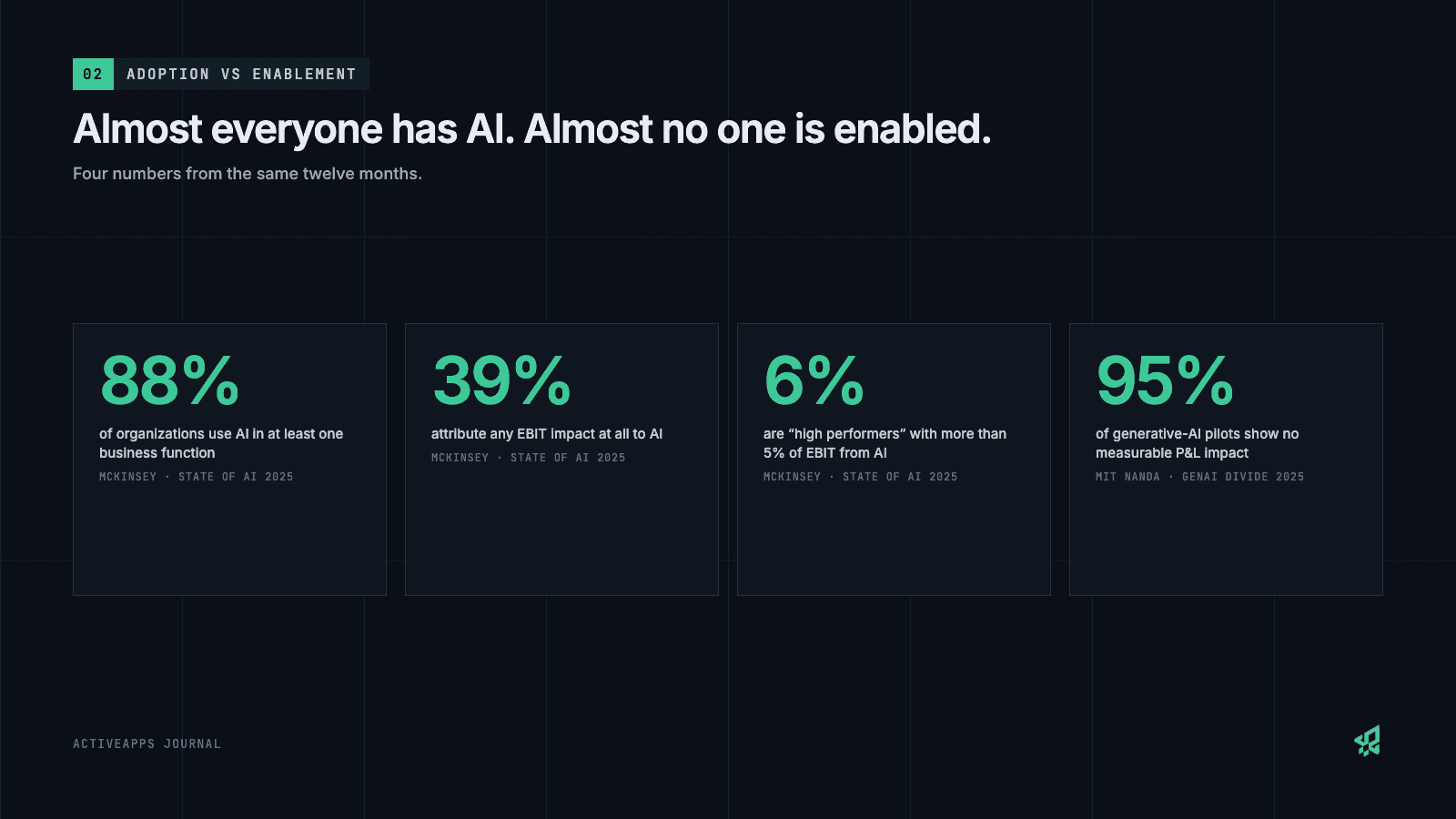
88% of organizations now use AI somewhere, but only 39% can attribute any EBIT impact to it and only about 6% are what McKinsey calls high performers (State of AI, 2025).
MIT’s NANDA group found 95% of generative-AI pilots deliver no measurable P&L impact after $30–40 billion of spend — not because the models fail, but because the organization around them was never designed for AI to plug into.
Five structural tests predict which side of that line a company lands on: one system of record per object, written definitions, documented process, no human bridge between systems, and a named owner per outcome.
Most mid-market companies we meet pass one or two. The order of repair matters: ownership and definitions first (they cost decisions), then systems and integrations (they cost engineering), then — only then — the AI layer.
Everyone bought the tools. Almost no one is enabled.
By the time a company calls us, it has usually already “done AI.” There is a copilot in the CRM, a chatbot on the support site that was switched on in a weekend, and a slide from a vendor showing a 3.5x return. Ask what changed in the P&L and the room goes quiet.
That quiet is now a measured phenomenon. McKinsey’s 2025 State of AI survey of 1,993 executives found that 88% of organizations use AI in at least one business function. Only 39% attribute any EBIT impact to it at all, and most of those say the impact is under 5% of EBIT. The group McKinsey calls high performers — more than 5% of EBIT from AI — is about 6% of respondents. Gartner’s September 2026 C-suite survey lands in the same place from a different angle: only 22% of organizations have scaled AI across multiple business units.
MIT’s Project NANDA put the sharpest number on it. After reviewing more than 300 public AI initiatives, 52 structured interviews and 153 executive surveys, the group concluded that 95% of generative-AI pilots produce no measurable P&L impact, against $30–40 billion of enterprise investment. Their explanation is worth quoting in spirit: the failing systems don’t retain feedback, don’t adapt to context and don’t integrate into workflows. In other words, the pilots were never connected to the operation they were supposed to change.
The uncomfortable implication for an executive team is that the tool decision was never the decision. Adoption is close to universal and it bought almost nothing. What separates the 6% from the 88% is whether the organization underneath the tools was designed for AI to act on — and that is something you can test in an afternoon.
What “AI-enabled” means, in one sentence
An AI-enabled organization is one where AI can act on the company’s real data, inside its real workflows, with a named person accountable for the outcome. Every word in that sentence is a test. Real data means one system of record per business object, not three competing versions of the customer. Real workflows means a documented process with decision rules, not a habit that lives in one person’s head. A named person means a metric with an owner, not a task force.
BCG’s rule of thumb for where AI value comes from is 10% algorithms, 20% technology and data, 70% people and process. That ratio is a good description of the five tests below: one of them is about technology, none of them is about models, and four of them are about how the company decides things.

The five tests
Test 1 — Every business object has exactly one system of record
Ask where the customer lives. In a healthy company the answer takes three seconds: “Salesforce; billing reads from it.” In most companies the answer is a paragraph. Marketing keeps its own list in HubSpot because the CRM “wasn’t set up for campaigns.” Finance keeps the real one in the billing system because that is where the invoices are. Customer success has a spreadsheet, because of course it does.
An AI agent pointed at that landscape has three versions of the truth to choose from and will pick the wrong one at the worst moment — usually in front of the customer. The 2026 MuleSoft Connectivity Benchmark counts 957 applications in the average enterprise, with 27% of them integrated; 96% of IT leaders say agent success depends on data integration. The test is not whether you have many systems. It is whether each object — customer, deal, invoice, ticket — has one home that every department names without a meeting.
Test 2 — Definitions are written down, not negotiated
What is a lead? When does a customer churn? What counts as pipeline — and does the board deck use the same rule as the sales dashboard? If those definitions live in people’s heads, every model you train and every agent you deploy inherits the disagreement, and it inherits it silently.
Gartner’s data-management research found that 63% of organizations either lack the practices AI-ready data requires or aren’t sure they have them, and predicted that through 2026, 60% of AI projects unsupported by AI-ready data would be abandoned. The definition set is the cheapest part of AI-ready data and the one most companies skip, because it forces a conversation between marketing, sales and finance that nobody enjoys. Have it once, write it down, version it. It costs a meeting.
Test 3 — The workflow exists as a process, not a habit
AI automates documented processes. It cannot automate a person’s intuition about what to do next, and it will not discover the decision rules by itself. Before an agent can route tickets, qualify leads or reconcile invoices, someone has to write down how that decision is made today: what gets escalated, what never gets promised, which fields get updated and when.
This is the step where pilots quietly die. Lucid’s 2025 AI readiness survey of roughly 2,200 knowledge workers found only 16% describe their workflows as extremely well-documented. The instinct is to let the AI “figure it out” from examples. It will figure out something — and nobody will be able to say whether it is the process you wanted.
Test 4 — Data moves between systems without a human bridge
Salesforce’s own State of Sales research has reported for years that sellers spend under 30% of their time selling; the 2026 edition puts it at 40%, with the rest going to administration and moving information between tools. Every one of those manual hops is a place where AI context is lost and a place where an automated workflow will break at 2 a.m. on a Sunday.
The test is blunt: is there a spreadsheet export anywhere in a core workflow? If yes, AI will make the export faster and the workflow no more reliable. AI-enabled companies have closed those gaps with maintained integrations that carry context automatically — and each integration has an owner who gets paged when it fails.
Test 5 — Someone owns the outcome, by name
Not a committee. Not the AI task force. One person whose goals contain the business metric that AI is supposed to move — first-response time, lead-to-opportunity conversion, forecast accuracy. In our experience this is the single strongest predictor of whether a pilot ever reaches production, and it is the one test that costs nothing but a decision.
The pattern is visible in the survey data too. Gartner’s AI maturity research found 91% of high-maturity organizations have appointed dedicated AI leaders, and IBM’s 2026 CEO study reports 76% of organizations now have a Chief AI Officer, up from 26% a year earlier. The title matters less than the fact that a name is attached to an outcome. Ownership is what turns a demo into a system that survives the next quarter.
What we actually see
A pattern from the first weeks of engagements — this is what we observe, not a controlled study. The typical mid-market technology company passes Test 1 partially (Salesforce is the system of record for deals, nobody agrees who owns the customer after the deal closes), fails Test 2 (three definitions of a qualified lead, one per department), fails Test 3 (the process is documented in a Confluence page last edited in 2023, and the team does something else), passes Test 4 for the two integrations someone built well and fails it for the rest, and has never considered Test 5 because the AI initiative reports to a steering committee.
The interesting part is that the same company usually has a genuinely good AI pilot running somewhere. It demos beautifully. It is fed by a spreadsheet one analyst refreshes every Monday, and if that analyst leaves, the pilot stops. That is what a Stage-2 company looks like from the inside, and it is exactly the 95%.
Where to start
Run the five tests in writing, with the executive team in the room, and score them honestly — “mostly” is a no. Two passes out of five is normal and it is not a failure; it is the roadmap. Then repair in this order, because the sequence decides the cost.
Week 1: ownership and definitions. Name one accountable owner for the AI outcome, and write the definition set for lead, opportunity, customer, churn and revenue. Both are decisions, not software. They cost a meeting each.
Weeks 2–6: systems of record and the human bridges. Declare one home per object and replace the exports inside the target workflow with maintained integrations. This is engineering, and it is the bulk of the work.
Weeks 4–8: document the target workflow as decision rules — escalation, promises, field updates — and record the baseline metric before anything ships.
Only then: choose the AI layer. Whether that is Agentforce, Breeze, Copilot or a custom agent matters far less than the fact that it now has something solid to act on.
Companies that start from the AI layer end up doing this list anyway, later, under pressure, after the pilot has burned its sponsor’s patience. Companies that start from the list get to the AI layer in a quarter and stay there.
The practical output of the exercise is a one-page readiness scorecard. We publish the full version — the same 30-plus checks we run inside Salesforce and HubSpot environments before any AI work begins — as the AI Readiness Health Check. Run it before the next tool purchase, with us or without.
Related reading
AI transformation: the complete guide for mid-market technology companies — the definition, the four stages and the twelve-month roadmap in one place.
The AI readiness checklist: 12 questions to answer before you buy another AI tool — the twelve questions behind the five tests.
The AI Readiness Health Check: 36 checks to run on Salesforce or HubSpot — the instrument we run before any AI work.
From pilot to AI-native: the four stages and how to know which one you’re in — where the second-use-case test comes from.
Sources: McKinsey, The State of AI 2025; MIT Project NANDA, The GenAI Divide: State of AI in Business 2025; Gartner, C-Suite AI Survey, September 2026; Gartner, “Lack of AI-Ready Data Puts AI Projects at Risk,” February 2025; Gartner, AI maturity survey, June 2025; BCG, The Leader’s Guide to Transforming with AI; MuleSoft, 2026 Connectivity Benchmark; Salesforce, State of Sales 2026; Lucid, AI Readiness Report 2025; IBM, 2026 CEO Study.
Frequently asked questions
What does it mean for an organization to be AI-enabled?
An AI-enabled organization is one where AI can act on the company’s real data, inside documented workflows, with a named owner accountable for the business outcome. It is a property of the operating model — systems of record, definitions, process, integrations and ownership — not of how many AI tools the company has licensed.
How is AI-enabled different from AI-ready?
AI readiness is the assessment: can your data, systems and processes support an AI initiative without a rebuild? AI-enabled is the state after the gaps are closed and at least one AI workflow runs in production with an owner and a measured result. Readiness is the scorecard; enablement is the outcome.
Why do most AI pilots fail to reach production?
Because the pilot was never connected to the operation it was meant to change. MIT’s 2025 research found 95% of generative-AI pilots show no measurable P&L impact; the usual causes are hand-prepared data that nobody maintains, an undocumented process the agent cannot follow, and no single owner accountable for the result.
Which of the five tests should a company fix first?
Ownership and definitions, because they cost decisions rather than engineering and every later step depends on them. Then systems of record and integrations. Choosing the AI platform comes last — it is the least important decision on the list and the one most companies make first.
Does a mid-market company need a Chief AI Officer to be AI-enabled?
It needs a named owner with a metric; the title is secondary. IBM reports 76% of organizations now have a Chief AI Officer, but in a 300–2,000-person company the owner is often the COO, CRO or a head of business systems. What matters is that one person’s goals contain the number AI is supposed to move.
How long does it take to become AI-enabled?
For a mid-market company with Salesforce or HubSpot as its system of record, the foundation work — ownership, definitions, systems of record, integrations for one workflow — typically fits in a quarter. Deloitte’s research puts satisfactory ROI on a typical AI use case at two to four years; companies that do the foundation first are the ones that beat that.
NEXT STEP
See where your organization stands before the next AI purchase.
A short conversation is enough to tell whether the AI Readiness Health Check, 36 checks on your Salesforce or HubSpot org, is the right first step. No decks, no obligations.
WRITTEN BY
Tal Oryon
MORE NOTES

Guide
AI transformation: the complete guide for mid-market technology companies
What AI transformation is, what it is not, the four stages, the readiness test, a twelve-month roadmap, and the questions executives ask most. Written for 300–2,000-person companies running Salesforce or HubSpot.

Guide
The AI Readiness Health Check: 36 checks to run on Salesforce or HubSpot before any AI goes live
An open checklist of 36 concrete, verifiable checks across data quality, data model, ownership, integrations, process, permissions, reporting lineage and AI prerequisites — with what to measure, why it matters for AI, and a scoring rule.